
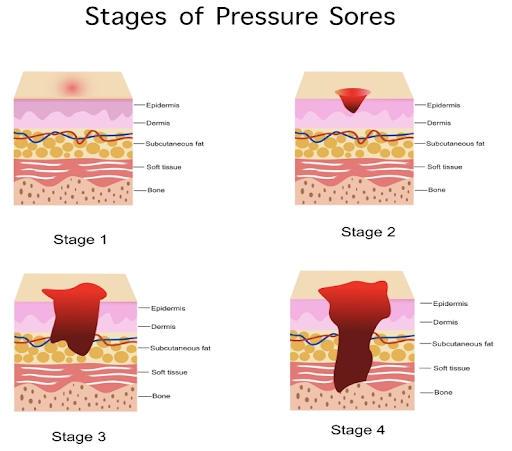
Decubitus ulcer classification is primarily visual but may be assisted by palpation. There are four stages (I-IV), understanding that a Stage I decubitus ulcer may have a deep tissue injury that is not yet visible on clinical exam. Suspected deep tissue injury is evidenced by subcutaneous bruising, which may become a deeper injury or a Grade III-IV decubitus ulcer.
Stage I: Non-blanchable redness over a bony prominence
Stage II: Partial dermis loss
Stage III: Full-thickness tissue loss
Stage IV: Full thickness tissue loss with exposed bone, tendon, or muscle.
Dr. Greg Vigna, MD, JD, Physical Medicine and Rehabilitation Specialist and Wound Care Expert, states, “Access to life-saving reconstructive surgery for Stage III and Stage IV pressure injuries has been cut by the Federal Government.”
Code of Federal Regulations 42 U.S.C. § 1395ww(m)(6)(A):
“Under this dual-rate structure, generally a LTCH is no longer reimbursed at the standard Federal rate if the patient did not spend at least three days in a hospital’s intensive care unit immediately preceding the LTCH care, or did not receive at least 96 hours of respiratory ventilation services during the LTCH stay.”
Dr. Vigna continues, “As the Medical Director of the Wound Care Program at Specialty Hospital of North Louisiana, we provided plastic surgery reconstructive procedures and saved the lives of 300-400 patients who elected for curative care and provided the standard of care for wound care in thousands of other patients between 2000 and 2010.”
Why is reconstructive surgery necessary? Dr. Laura Damioli, MD, described the outcome for Stage 3 and Stage 4 decubitus ulcers that are not provided with flap closure:
“We describe treatments and outcomes of hospitalized patients with decubitus ulcer-related osteomyelitis who did not undergo surgical reconstruction or coverage.
Within 1 year, 56 (63%) patients were readmitted, 38 (44%) patients were readmitted due to complications from osteomyelitis, and 15 (17%) died.
Among patients with decubitus-related osteomyelitis who did not undergo myocutaneous flapping, outcomes were generally poor regardless of treatment, and not significantly improved with prolonged antibiotics.”[2]
What does the Wound Healing Society Guidelines 2023 update say about flaps for cure?
“Preamble: Surgical treatment of pressure injury/ulcers is often considered to be a final invasive choice for wounds refractory to less aggressive care or for use when rapid closure is indicated; however, recent literature suggests that surgery can and should be performed safely in properly selected patients.”[3]
What do Harvard plastic surgeons say about the surgical treatment of decubitus ulcers?
Despite patients with poor. Baseline functional status, flap coverage for pressure ulcer patients is safe with acceptable postoperative complications. This type of treatment should be considered for appropriately selected patients.”[4]
Read the Book by Greg Vigna, MD, JD, regarding the treatment of pressure injuries:
[2] Damioli, et al. Retrospective analysis of the management of pelvic decubitus ulcers and their outcomes. Therapeutic Advances in Infectious Disease. 2023, Vol. 10: 1-9.
[3] Gould, et al. WHS guidelines for the treatment of pressure ulcers-2023 update. Wound Repair and Regeneration. Vol . 32, Issue 1, pp.6-33.
[4] Tran, Chen, et al. National perioperative outcomes of flap coverage for pressure ulcers from 2005 to 2015 using the American College of Surgeons National Surgical Quality Improvement Program. Arch Plast Surg 2018; 45(05): 418-424.
Injury Care Solutions Group (ICSG) provides educational expert content that does not constitute medical advice, diagnosis, treatment, or legal advice or solicitation. ICSG is not a law firm or medical provider. Use of this website does not create a doctor–patient or attorney–client relationship. Do not send PHI through this Website. Attorney references (including references to Ben Martin Law Group) are for convenience only, and are not endorsements, guarantees or attorney advertising. Past results do not predict future outcomes. See Full Disclaimer and Privacy Policy. If deemed attorney advertising: Ben C. Martin, 4500 Maple Ave., Suite 400, Dallas, Texas 75219, licensed by the State Bar of Texas and Pennsylvania.